What is the Pilot Routine?
The Pilot Routine (PiRou) is a standardised routine designed as a physiological assessment instrument in artistic swimming. All swimmers perform it with the same music, the same structure and the same technical elements, allowing the physiological responses of each swimmer to be compared throughout the season and between swimmers from different teams, categories and levels.
Its main purpose is to assess, under controlled conditions, the cardiovascular responses to apnea that characterise this sport, in which routines alternate phases of intense exercise with the face in the water (hybrids, in apnea) and phases with the face out of the water (transitions, breathing).
Structure
The PiRou is organised into blocks, each consisting of a transition (TR), with the face out of the water (breathing), followed by a hybrid (HIB), with the face in the water (apnea). The duration of each segment is set by the music, so the temporal sequence is identical in every performance.
PiRou Junior/Senior — 6 blocks · 155 s (2:35)
95 s in apnea (≈60%) and 60 s breathing (≈40%).
PiRou Youth — 5 blocks · 120 s (2:00)
Shorter, adapted version with reduced apneas: 75 s in apnea (≈60%) and 45 s breathing (≈40%).
Hybrid codes
In each version of the PiRou there is a reference hybrid, which is that of Block 1. For the remaining blocks, the same codes are repeated until the set seconds are reached. In the Junior/Senior version, Block 3 has slight adaptations in the hybrid: the F1a is replaced by F3a and the RU1 is removed. The codes follow the World Aquatics difficulty nomenclature.
Junior/Senior (reference hybrid: 30 s)
| Block | HIB duration | Code |
|---|---|---|
| 1 | 30 s (reference) | A4b F6c RD1 F1a RC1 F7 A8 SC1 F4f F6c F9 F1a RC1 RU1 F4f F5a A3 A7 S2 T4e |
| 2 | 10 s | A4b F6c RD1 F1a RC1 F7 A8 |
| 3 | 20 s | A4b F6c RD1 F1a RC1 F7 A8 SC1 F4f F6c F9 F3a RC1 F4f F5a |
| 4 | 15 s | A4b F6c RD1 F1a RC1 F7 A8 SC1 F4f F6c |
| 5 | 10 s | A4b F6c RD1 F1a RC1 F7 A8 |
| 6 | 10 s | A4b F6c RD1 F1a RC1 F7 A8 |
Youth (reference hybrid: 25 s)
| Block | HIB duration | Code |
|---|---|---|
| 1 | 25 s (reference) | A4b F6c RD1 F1a RC1 F7 A7 SC1 F4f F5a F7 F3a A6 S1 T4e |
| 2 | 10 s | A4b F6c RD1 F1a RC1 F7 A7 |
| 3 | 15 s | A4b F6c RD1 F1a RC1 F7 A7 SC1 F4f F5a |
| 4 | 15 s | A4b F6c RD1 F1a RC1 F7 A7 SC1 F4f F5a |
| 5 | 10 s | A4b F6c RD1 F1a RC1 F7 A7 |
Course
The routine starts directly from the water, always in a straight line and in the centre lane of the pool, where it also finishes.
Junior/Senior — 3 lengths
Youth — 2 lengths
How to administer the PiRou
- Prior familiarisation: swimmers should practise the PiRou during their usual training sessions in the weeks before any testing, until they can perform it fluently with the music.
- Starting position: eggbeater, in the centre lane.
- Start: 5 – 4 – 3 – 2 – 1 countdown and start of the official PiRou music. The whole routine is synchronised with the music.
- Performance: the transition–hybrid alternation set by the music must be strictly respected, without modifying elements or durations.
- End: after the last hybrid, the swimmer surfaces to breathe.
Demonstration videos
PiRou Junior/Senior
PiRou Youth
Official music
Pilot Routine Junior/SeniorPilot Routine YouthDownloads
Origin and scientific validation
The PiRou is one of the outcomes of the SynchroProject, the artistic swimming research line of the Grup de Recerca en Ciències de l’Esport INEFC Barcelona (GRCEIB). It has been designed on the basis of the scientific evidence generated by the group on the structure of competitive routines and the physiological responses to apnea in this sport.
As with any measurement instrument, the PiRou must undergo a rigorous validation process: content validity through a panel of expert coaches, a pilot study, construct validity and test-retest reliability. This process begins in the project “Monitoring Cardiac Responses and Adaptations to Apnea in Artistic Swimming”, in which the underwater cardiac recordings of swimmers of different categories will be monitored during the performance of the PiRou using non-invasive chest-strap sensors. The study has been approved by the Research Ethics Committee (CEIm) of the Consorci Sanitari de Terrassa and by the Bioethics Committee of the Universitat de Barcelona.
Isolated hybrids protocol
Alongside the complete PiRou, the project includes an isolated hybrids protocol: short blocks made up of one transition and a single hybrid, performed independently and with full recovery between them. While the PiRou reproduces the continuous alternation of apneas typical of a routine, the isolated hybrids make it possible to study the cardiac response to apneas of progressively longer duration, without the accumulated fatigue of the preceding blocks.
Youth and Junior/Senior
Youth and Junior/Senior
Youth and Junior/Senior
Elite Junior/Senior only
Correspondence with the PiRou hybrids
The isolated-hybrid sequences are built from the same elements and the same counts as the PiRou, so the swimmers already know them. Junior and senior swimmers work with the elements of the PiRou Junior/Senior and youth swimmers with those of the PiRou Youth. The correspondence is as follows:
Junior/Senior
- 20 s apnea: the hybrid of block 3 of the PiRou (the 20 s one), complete and with the same counts; only the ending changes: instead of going down into the water after the F5a, three short elements are added before coming up to breathe.
- 25 s apnea: the hybrid of block 1 of the PiRou (the 30 s one) up to and including the A7; it ends with a simple spin (S1) instead of the S2 and the barracuda.
- 30 s apnea: the hybrid of block 1 of the PiRou in full, with the same code; only the counts of the final barracuda are adjusted.
- 40 s apnea (elite Junior/Senior only): the hybrid of block 3 of the PiRou (the 20 s one) performed twice in a row, linked by an F1b, and with a final closing of RD1, RU1 and S1 instead of going down into the water after the F5a; there is no barracuda.
Youth
- 20 s apnea: the hybrid of block 1 of the PiRou Youth (the 25 s one) up to and including the A6; the S1 and the barracuda are removed and the swimmer comes up to breathe directly.
- 25 s apnea: the hybrid of block 1 of the PiRou Youth in full, with the same code; only the counts of the final barracuda are adjusted.
- 30 s apnea: the hybrid of block 3 of the PiRou Youth is repeated twice (15 s + 15 s).
The full detail, movement by movement and count by count, for both categories, is available in the downloadable document.
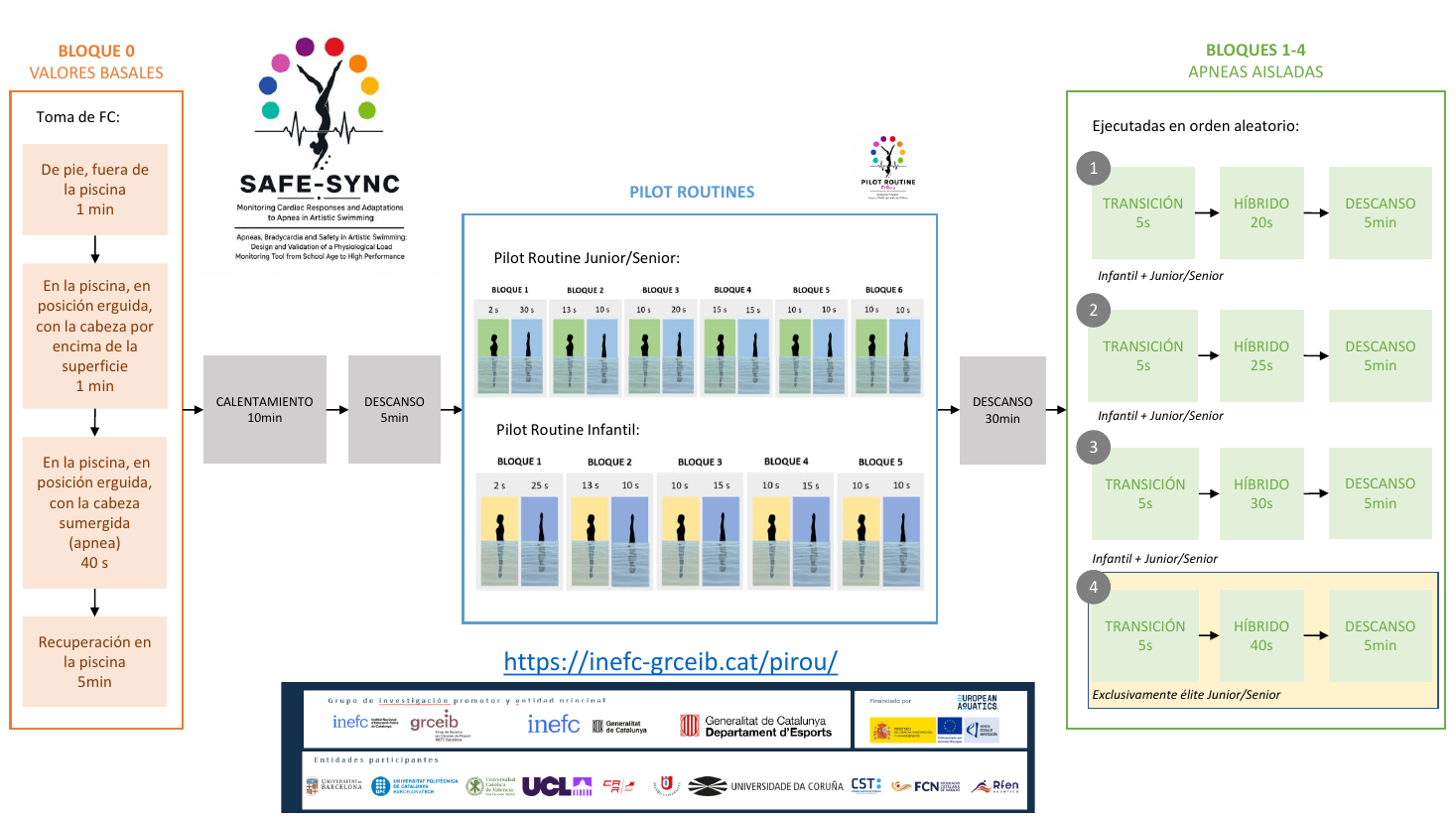
Structure of session 1
The isolated hybrids and the PiRou are recorded in the same session, in the following order:
- Block 0, baseline values. Heart rate recording standing outside the pool (1 min), in the water in an upright position with the head above the surface (1 min), in apnea with the head submerged (40 s) and recovery in the pool (5 min).
- Warm-up (10 min) and rest (5 min).
- Pilot Routines: PiRou Junior/Senior and PiRou Youth, depending on the category.
- 30 min rest.
- Blocks 1 to 4, isolated apneas, in random order, with 5 min of rest between blocks.
Audio tracks for the isolated hybrids
Audio tracks with the countdown and the music for each block, matching the duration of the hybrid.
Hybrid 20 sHybrid 25 sHybrid 30 sHybrid 40 sDocuments and downloads